
Writers spend hours on openings and then rush the ending. That is a missed chance. The last lines of a story are often the ones readers remember, quote and share.
Our editors read a lot of endings. These are the approaches that work best, and the mistakes we see most often.
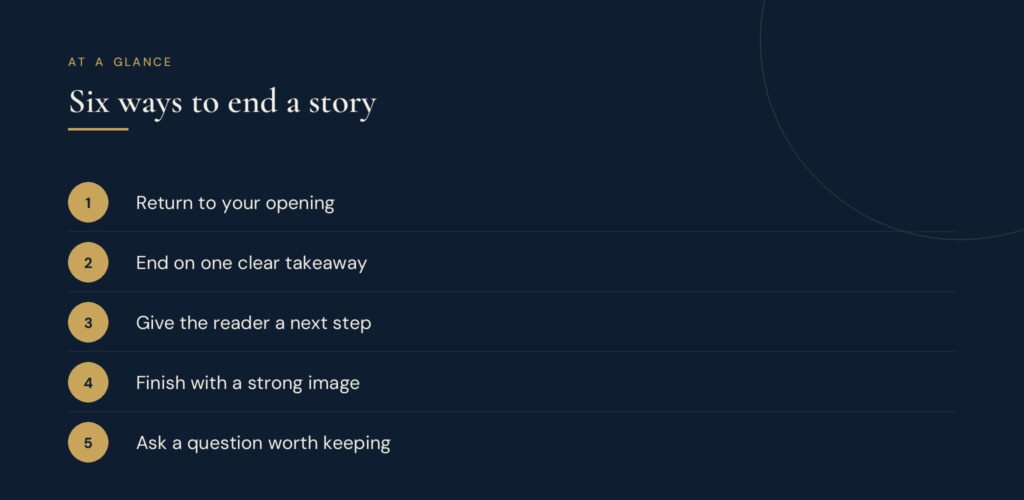
Six ways to end a story well
1. Return to your opening
If you began with a scene, a question or a person, come back to it. Readers enjoy seeing how things have changed since the first paragraph.
2. End on one clear takeaway
If the reader remembers only one sentence, what should it be? Put that sentence near the end, in plain words.
3. Give the reader a next step
For practical stories, finish with one simple action the reader can take today.
4. Finish with a strong image
A concrete detail can say more than a summary. Show the result rather than explaining it.
5. Ask a question worth keeping
A thoughtful question invites readers to apply the story to their own lives. Use this sparingly, and make the question genuine.
6. Stop when you are done
Sometimes the best ending is simply the last useful sentence. Do not add more just to feel finished.
Common mistakes in conclusions
- Repeating everything. A long summary of the points readers just read feels like padding.
- Introducing new ideas. A fresh argument at the end leaves readers confused.
- Ending with "In conclusion". You do not need to announce the ending.
- Fading out. A vague final line, such as "only time will tell", weakens the whole story.
A quick editing test
Cover your last paragraph and read the one before it. If the story still feels complete, your ending may be unnecessary. If something is clearly missing, your ending is doing its job. Now make sure it does that job in as few words as possible.




Join the conversation
Sign in or join Parchment to respond.