

Ask experienced writers for their best advice and many will say the same thing: read more. It sounds too simple to be useful. But reading is how we absorb rhythm, structure and vocabulary without having to think about rules.
Reading trains your ear
When you read good writing, you start to notice when a sentence sounds right and when it drags. Over time, that instinct shows up in your own drafts. You cut the extra word without being told to.
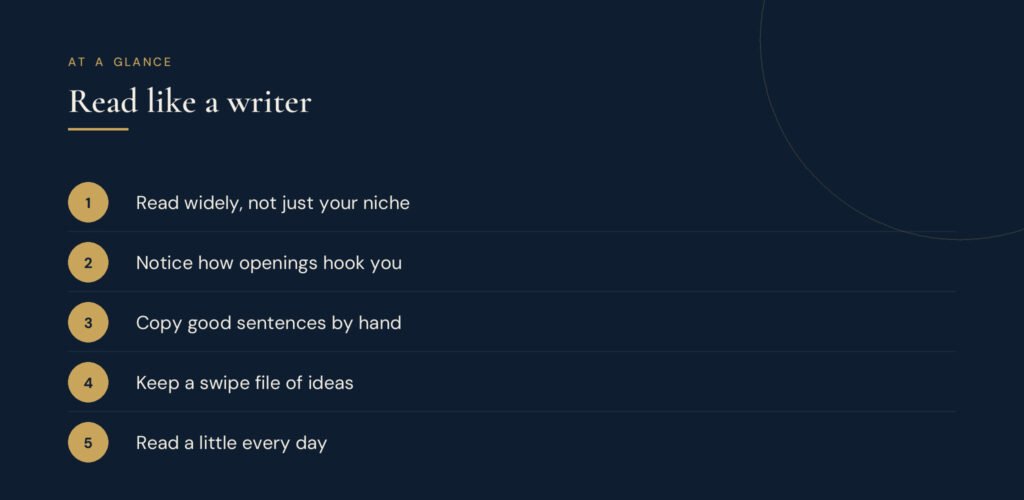
Read like a writer, not only like a reader
When something grabs you, pause and ask why:
- How did the opening hook me? A question, a surprising fact, a small story?
- Why did I keep turning pages? Short paragraphs, open questions, a clear promise?
- What made this sentence memorable? A specific detail, a strong verb, a pause?
These questions turn reading into practice.
Read outside your niche
If you write about business, read fiction. If you write fiction, read journalism. Different kinds of writing solve problems in different ways, and borrowing those solutions keeps your work fresh.
Keep a swipe file
Save headlines, openings and sentences you admire in a notes app. When you are stuck, browse it for ideas. You are not copying; you are learning the patterns behind good writing.
Make time for reading
- Replace a few minutes of scrolling with a few pages of a book.
- Keep something to read with you, on paper or your phone.
- Read on Parchment, and leave a like on stories that teach you something.
Ten minutes a day adds up to many books a year.
Then write
Reading fills the well; writing draws from it. Balance both, and you will see your writing improve faster than with either alone.




Join the conversation
Sign in or join Parchment to respond.